FUT vs FUE Hair Transplant: Which Technique Is Better for Hair Loss?
Hair loss has become one of the most common appearance concerns among both men and women, especially when a receding hairline, thinning crown, or visible scalp starts affecting confidence. The two most talked-about options in modern Hair Restoration Surgery are Follicular Unit Transplantation (FUT) and Follicular Unit Extraction (FUE). Both are designed to move healthy follicular units from a stable donor area to a balding recipient area, but the main difference lies in how the grafts are harvested. When patients search for hair transplant fue vs fut, they are usually trying to understand recovery, scarring, graft quality, cost, and which method suits their pattern of hair loss better. At Viva Aesthetic Clinic’s Hair Transplant in Mumbai, treatment is planned around natural-looking results, modern technology, and individualized graft strategy under Dr. Deepam Shah.
What Causes Hair Loss?
Before comparing fut vs fue hair transplant, it is important to understand why hair loss happens. The most common cause is Androgenetic Alopecia, a hereditary form of hair loss influenced by androgen sensitivity, especially the effect of dihydrotestosterone on genetically susceptible follicles. Hair loss can also worsen due to aging, stress, hormonal imbalance, nutritional issues, or scalp conditions. In Dermatology, not every patient with thinning hair is automatically a transplant candidate, because the diagnosis must be clear before surgery is considered. The pattern and progression of hair loss are often assessed using the Norwood–Hamilton Scale, which helps doctors estimate baldness severity, donor strength, and future planning.
How Hair Transplant Surgery Works
A hair transplant is a surgical procedure in which healthy Hair Follicles are moved from a donor region, usually the back or sides of the scalp, to a thinning or bald area. The donor follicles are typically resistant to the hormonal effects that cause pattern baldness, which is why they continue to grow even after being implanted in a new area. The basic steps are donor harvesting, graft preparation, micro-incision or channel creation, and graft implantation. This is a key point in understanding the difference between fue and fut: both procedures use the same artistic implantation process, but differ in the harvesting stage.
Follicular Unit Transplantation (FUT) Explained
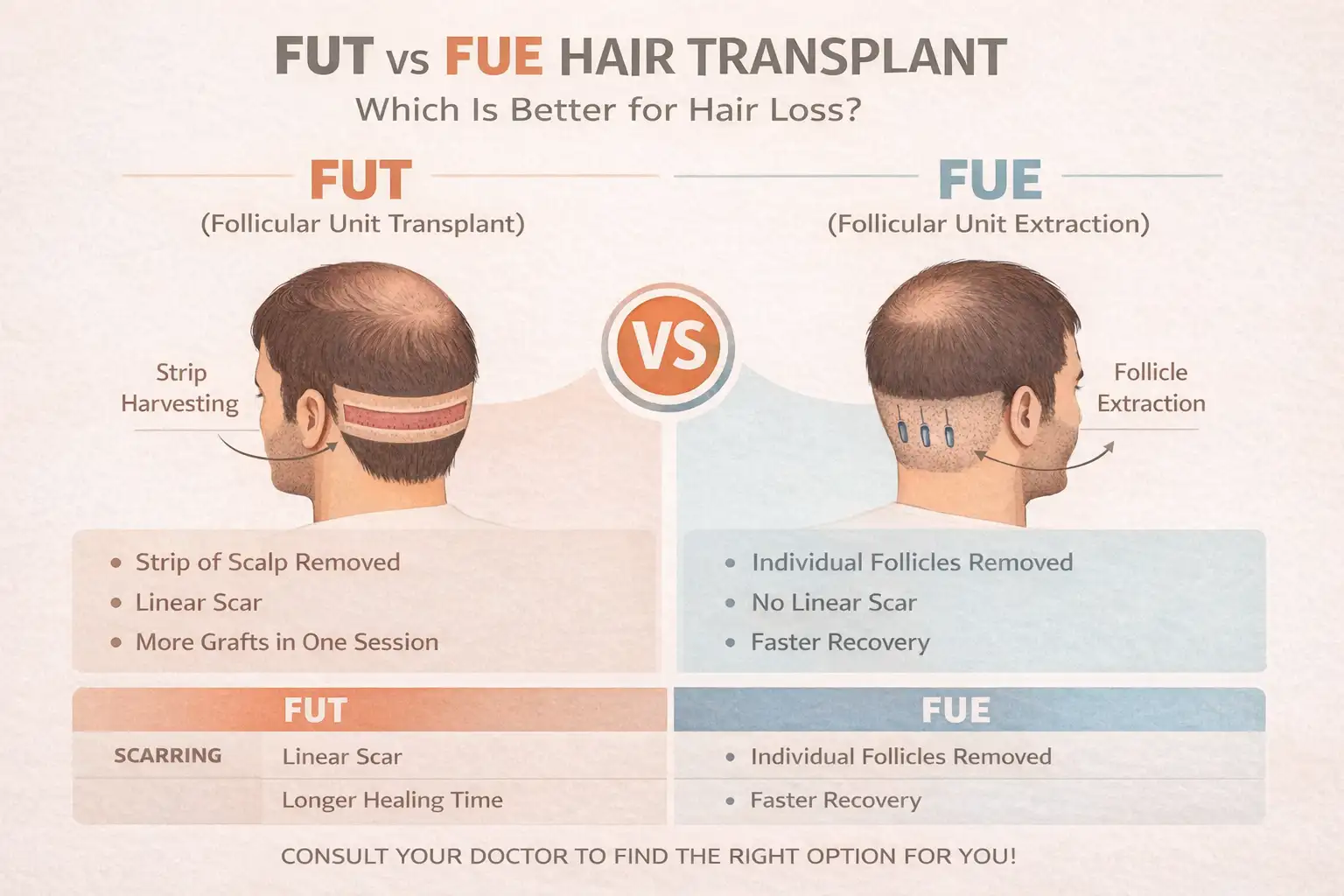
Follicular Unit Transplantation, often called the strip harvesting technique, involves removing a thin strip of scalp from the donor area. That strip is then dissected under magnification into individual follicular grafts, which are implanted into the recipient area. FUT remains relevant because it can be very efficient for harvesting large graft numbers in a single sitting, particularly in patients with more advanced baldness. This is one reason why the question fut or fue which is better cannot be answered with the same formula for every patient.
Advantages of FUT
FUT is often preferred when higher graft yield is needed in one session. It can be a practical option for patients with extensive hair loss who need broader coverage or higher density planning. Because a strip is removed from the donor zone, surgeons may be able to preserve surrounding donor hair more uniformly in selected cases. FUT is also often more cost-efficient than FUE in larger sessions.
Disadvantages of FUT
The main disadvantage of FUT is the linear scar in the donor area. It also involves sutures or staples, which means recovery can feel slightly longer or tighter than FUE. For patients who like very short hairstyles, that scar may become an important deciding factor.
Follicular Unit Extraction (FUE) Explained
Follicular Unit Extraction removes individual follicular units one by one using a small punch extraction tool. Instead of taking a strip of scalp, the surgeon harvests grafts from multiple points in the donor zone. These tiny circular wounds heal as small dot scars rather than a single linear scar. That is why fue vs fut hair transplant discussions often lean toward FUE among patients who want minimal visible scarring and a quicker cosmetic recovery. At Viva Aesthetic Clinic’s FUE Hair Transplant in Mumbai, the treatment is positioned as a modern, minimally invasive option planned by Dr. Deepam Shah, who is described by the clinic as MD, DNB, FAM and founder of the practice.
Advantages of FUE
FUE is popular because it avoids a linear scar, allows faster healing in the donor region, and suits patients who prefer short haircuts. It can also allow selective harvesting from beard or body hair in suitable cases when scalp donor supply is limited. For patients searching fue vs fut hair transplant because they want less downtime and a more discreet recovery, FUE often becomes the more appealing option.
Disadvantages of FUE
FUE can take longer because each graft is extracted individually. It is often more expensive, and poor planning can lead to overharvesting, which affects donor appearance. So while FUE is minimally invasive, it still requires surgical precision and long-term donor management.
FUT vs FUE Hair Transplant Comparison
Here is a simple comparison of fut versus fue:
| Factor | FUT | FUE |
| Technique | Strip removal | Individual follicle extraction |
| Scarring | Linear scar | Tiny dot scars |
| Recovery | Slightly longer | Usually faster |
| Graft Yield | Often higher in one sitting | Moderate to high depending on case |
| Surgery Time | Usually shorter for large sessions | Often longer |
| Cost | Usually lower | Usually higher |
In practical terms, both techniques can produce natural results when grafts are handled well and implantation is planned carefully. Published reviews emphasize that graft survival and final density depend heavily on surgeon expertise, graft handling, storage, and recipient-site planning rather than on marketing claims alone.
FUT vs FUE – Which One Should You Choose?
The answer depends on your stage of hair loss, donor hair density, hairstyle preference, lifestyle, recovery expectations, and budget. FUT may be a better fit if you have advanced baldness and need a high number of grafts in one session. FUE may be more suitable if you want minimal visible scarring and flexibility with shorter hairstyles. Patients also need to think beyond the current hairline and plan for future hair loss progression. That is why timing matters, and reading Best Age For A Hair Transplant can help patients understand when surgery makes more sense medically and aesthetically. Viva Aesthetic Clinic’s own page highlights the importance of experience, natural outcomes, and long-term planning in hair restoration.
Hair Growth Timeline After FUT or FUE
Recovery after both techniques follows a similar biological pattern because implantation is essentially the same. In the first month, shedding of transplanted hairs is common. Around months 3 to 4, early new growth usually begins. By months 6 to 9, density becomes more visible, and final maturation is commonly judged at about 12 months. This pattern reflects the natural Hair Growth Cycle and the way transplanted follicles re-enter active growth after surgery. Patients should not compare outcomes too early, because transplanted hair takes time to mature.
FUT vs FUE Cost in India
In India, the cost of FUT and FUE varies depending on graft count, clinic standards, surgeon experience, and the complexity of the case. FUE is usually more expensive because it is more labor-intensive and time-consuming. At Viva Aesthetic Clinic, the hair transplant pages emphasize customized treatment planning rather than a one-size-fits-all quote, and the clinic also offers a dedicated hair transplant cost page for patients who want budget guidance. For anyone researching hair transplant FUE vs FUT, cost should be considered along with donor management, result quality, and long-term planning.
Who Is the Right Candidate for Hair Transplant?
A good candidate for hair transplantation usually has patterned hair loss, a stable donor area, good scalp health, and realistic expectations. In Trichology and Dermatology practice, the best results come when the diagnosis is accurate and the hair loss pattern is stable enough for long-term planning. Men with male pattern baldness are common candidates, but women may also undergo FUT or FUE in selected cases. The decision should always be based on donor quality, scalp condition, and whether medical management is also needed.
Advanced Hair Transplant Techniques
Modern hair restoration has evolved beyond the basic FUT versus FUE discussion. Direct Hair Implantation, Sapphire FUE, and Robotic Hair Transplant approaches are all built on the principle of more refined graft handling and implantation. These techniques are often presented as advanced versions or refinements of FUE rather than completely separate concepts. Viva Aesthetic Clinic’s recent technology page also highlights advanced hair transplant technology as part of its hair restoration offering, reinforcing that technique alone is not enough without careful surgical planning.
Why Patients Consider Viva Aesthetic Clinic
For patients considering a Hair Transplant in Mumbai, clinic experience matters as much as technique. Viva Aesthetic Clinic describes Dr. Deepam Shah as a dermatologist, cosmetologist, and hair transplant surgeon with over a decade of experience. The clinic’s hair transplant page states that it is fully operated by Dr. Shah and highlights 3,000+ hair transplant surgeries, while other official site pages describe the clinic as a state-of-the-art setup in South Mumbai with advanced lasers and medical devices. The clinic also operates from Opera House and Colaba, which helps patients from different parts of South Mumbai access consultation and follow-up care.
FAQs
Is FUE better than FUT?
Not always. FUE is often preferred for minimal visible scarring and faster recovery, while FUT can be better for high graft numbers in a single session.
Does FUT leave a permanent scar?
Yes, FUT usually leaves a linear donor scar, though its visibility varies with healing, closure technique, and hairstyle.
How many grafts are needed for a hair transplant?
That depends on the degree of baldness, donor density, hair characteristics, and the area to be covered.
Is hair transplant permanent?
Transplanted donor hair is usually long-lasting because it comes from more resistant areas of the scalp, though native surrounding hair may continue to thin.
Which technique gives more density?
FUT can be advantageous when more grafts are needed in one session, but final density depends on hair characteristics, graft handling, and implantation planning.
Can women undergo FUT or FUE?
Yes, selected women can be candidates if their diagnosis, donor quality, and scalp condition are appropriate.
Is hair transplant painful?
The procedure is usually done under local anesthesia, so discomfort during surgery is controlled. Mild soreness can occur afterward.
How long does hair transplant surgery take?
It usually takes several hours, depending on the number of grafts and the technique used.
Conclusion
When comparing fut vs fue hair transplant, the real takeaway is simple: FUT is often chosen for higher graft efficiency and density planning, while FUE is preferred for minimal visible scarring and faster recovery. But the best method is the one that matches your hair loss pattern, donor reserve, long-term goals, and surgeon’s judgment. At Viva Aesthetic Clinic, patients can consult Dr. Deepam Shah for personalized advice on FUT, FUE Hair Transplant in Mumbai, timing, graft requirement, and expected results. To book an appointment, patients can use the Contact Us page or reach the clinic at Opera House and Colaba through the numbers listed on the official site, including 93245 89084 and 022 3573 1556.