
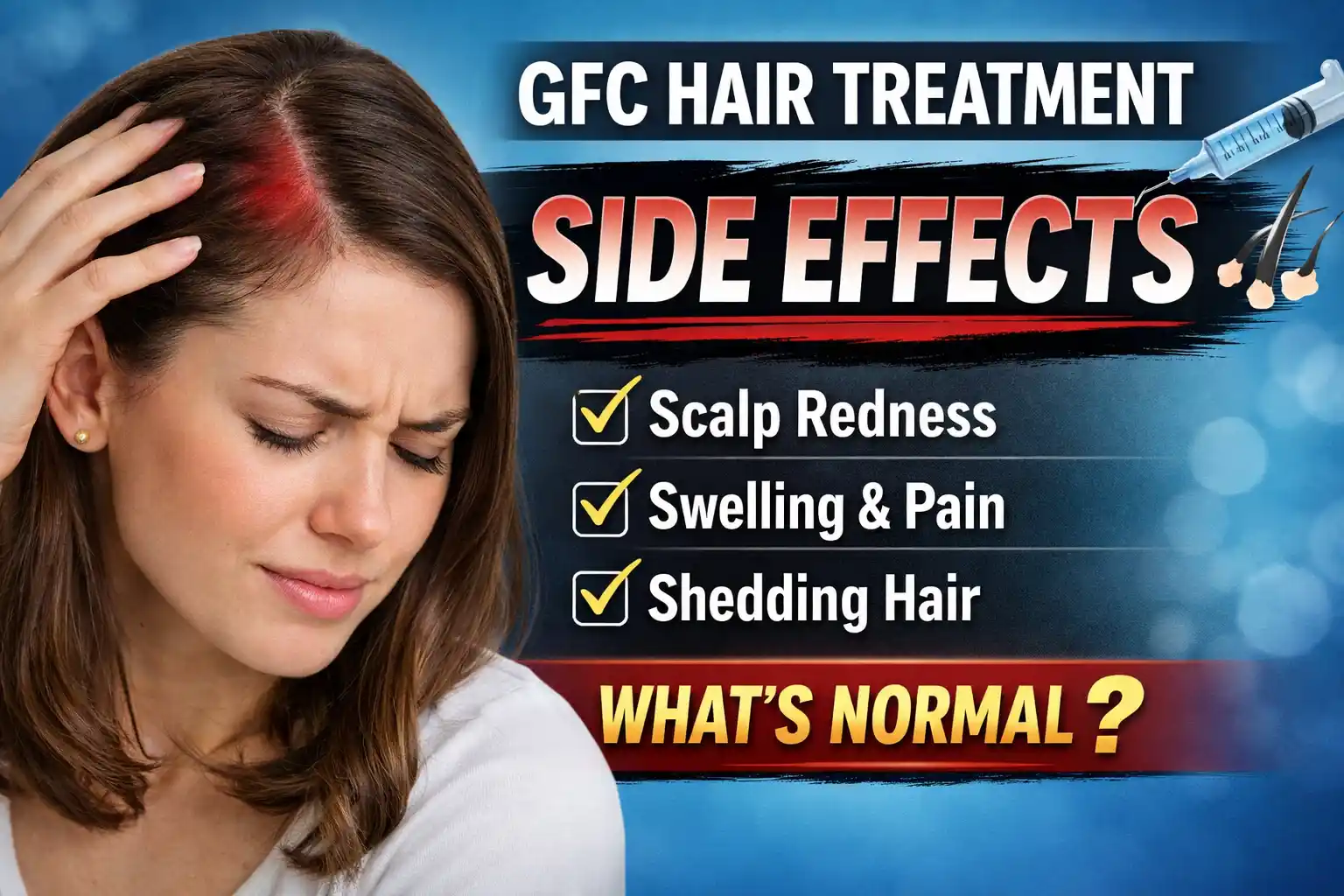
GFC Hair Treatment Side Effects: What to Expect (and What’s Normal)
If you’re researching GFC hair treatment side effects, you’re probably trying to answer one simple question: Is this safe for my scalp—and will I be able to go back to work the same day? For most people, Growth Factor Concentrate (GFC) therapy is well-tolerated because it uses your own blood-derived growth factors (autologous therapy) to support weaker hair follicles. That means the body usually accepts it well, and most reactions—if they occur—are mild, temporary, and related to the injection process rather than the “product” itself.
Below is a clear guide to GFC treatment side effects, how long they last, rare risks to know, and aftercare tips to keep recovery smooth.
What is GFC Hair Treatment?
GFC (Growth Factor Concentrate) is an advanced regenerative treatment designed for hair fall control and hair thinning. In simple terms, it concentrates growth signals from your own blood and delivers them directly into thinning scalp areas.
Why people choose it:
- Uses autologous (self-derived) growth factors
- Non-surgical and minimally invasive
- Usually involves minimal downtime
- Often used in early to moderate hair loss, where follicles are still active
Because GFC is prepared from your own blood, GFC side effects are generally limited and most commonly linked to micro-injections into the scalp.
How GFC Hair Treatment Works
Procedure steps (step-wise)
- Scalp assessment & planning
Your doctor evaluates the thinning pattern, scalp health, and suitability. - Blood draw
A small sample of blood is collected. - Centrifugation/processing
The blood is processed to isolate and concentrate growth factors. - Scalp cleansing + optional numbing
The scalp is cleaned thoroughly; local numbing or numbing cream may be used for comfort. - Micro-injections into the scalp
The concentrated growth factors are injected into targeted thinning areas.
Mechanism of action (how it helps follicles)
- Supports the hair growth environment by encouraging cellular repair
- Helps improve scalp micro-circulation
- Aims to support a healthier hair growth cycle (results appear gradually because hair grows in cycles)
Common & Temporary Side Effects
Most side effects of GFC hair treatment are mild and settle quickly—often within hours to a couple of days.
Scalp Tenderness / Soreness
- Mild discomfort at injection points, often described as “tenderness.”
- Typically settles within a few hours to 1–2 days
Redness & Swelling
- Localised redness and mild swelling around treated areas
- This is a normal short inflammatory response to injections
- Usually fades within 24–72 hours
Bruising
- Minor bruising can occur where tiny blood vessels are nicked during injections
- Often fades within a week
- May be more noticeable in sensitive skin types
Itching or Tingling
- Some people feel mild itching or tingling as the scalp settles
- Usually resolves within a few days with gentle care
Minimal Discomfort During Injection
- Slight pinching or mild pain can occur during the injection process
- Most clinics reduce this with numbing creams/local anaesthesia and fine needles
In short, the most common GFC treatment for hair side effects are tenderness, mild swelling/redness, itching, and small bruises—temporary reactions related to the injection technique.
Potential Risks (Less Common)
Even though GFC has a strong safety profile, a few less common risks can exist.
Infection (Rare)
- Any injectable procedure can carry a small infection risk
- This is uncommon when sterile protocols are followed
- Proper aftercare and timely follow-up reduce the risk further
Allergic Reactions (Extremely Rare)
- Since GFC is derived from your own blood, an allergy is exceptionally uncommon
- Reactions are usually linked to something external (e.g., topical products used around the procedure) rather than the GFC itself
Prolonged Swelling or Bruising
- Some people with very sensitive skin, fragile vessels, or certain medical conditions may notice swelling/bruising that lasts longer than expected
- Generally improves with time and correct aftercare
No or Limited Hair Growth Response
- Not exactly a “side effect,” but it is an important expectation point
- People with advanced hair loss or scarring alopecia may see limited improvement because inactive follicles can’t respond well
Important Post-Treatment Considerations
No significant downtime
Most people return to daily routine right away. You may just feel mild scalp tightness or tenderness for a short period.
Aftercare tips (simple and practical)
- Avoid washing hair for a few hours to 24–48 hours, depending on your doctor’s advice
- Avoid heavy sweating, strenuous workouts, steam/sauna, and heat exposure for a short period
- Skip harsh chemical products (strong anti-dandruff shampoos, dyes, chemical treatments) immediately after the session
- Avoid direct sun exposure on the scalp right after treatment (cap/umbrella helps)
Following aftercare instructions is one of the best ways to keep GFC treatment side effects minimal.
Duration of Side Effects
Typical timeline:
- A few hours to 2–3 days: redness, mild swelling, tenderness, injection-site discomfort
- Up to 7 days: small bruises (if they occur)
- A few days: mild itching/tingling may linger slightly longer for some people, but remains temporary
If you notice worsening pain, increasing swelling, fever, discharge, or severe redness spreading beyond the injection areas, contact your doctor promptly.
Safety Profile and Who Should Avoid It
GFC is generally suitable for adults with early to moderate hair thinning—especially when follicles are still active.
You should be evaluated carefully (or may be advised to postpone/avoid) if you have:
- Active scalp infection or inflamed scalp conditions that need treatment first
- Bleeding/clotting disorders or are on blood-thinners (your doctor will guide medication/supplement adjustments)
- Any medical condition where injections are not currently advised by your treating physician
A proper scalp exam and medical history review are the safest way to decide if GFC is right for you.
GFC vs. Other Treatments
GFC vs PRP
Both are autologous regenerative therapies and are commonly discussed together.
- PRP (Platelet-Rich Plasma): uses platelet-rich plasma prepared from your blood and injected into the scalp.
- GFC: focuses on delivering a more refined concentrate of growth factors using a specialised processing method.
Side-effect comparison (general):
- Both usually have mild, injection-related reactions (tenderness, redness, swelling, bruising).
- Some patients report that GFC feels slightly more comfortable or has fewer temporary reactions—but individual experiences vary, and technique matters most.
If you’re deciding between them, your dermatologist can guide you based on your hair loss stage, scalp condition, and response to previous therapies.
FAQs
Does GFC hair treatment hurt?
Most people describe it as mild discomfort rather than pain. Numbing cream or local anaesthesia can be used to keep injections comfortable.
How soon do side effects subside?
In most cases, within hours to a few days. Minor bruising (if any) can take up to a week to fade.
Can side effects worsen with multiple sessions?
Usually not. With proper technique and aftercare, side effects remain mild and temporary across sessions.
Conclusion
Overall, GFC side effects are usually mild, short-lived, and manageable—most commonly tenderness, redness, mild swelling, itching, or small bruises related to scalp injections. When done under sterile conditions by trained practitioners, GFC therapy offers an excellent safety profile with minimal downtime, and it can be a valuable option for suitable candidates dealing with early to moderate hair thinning.