
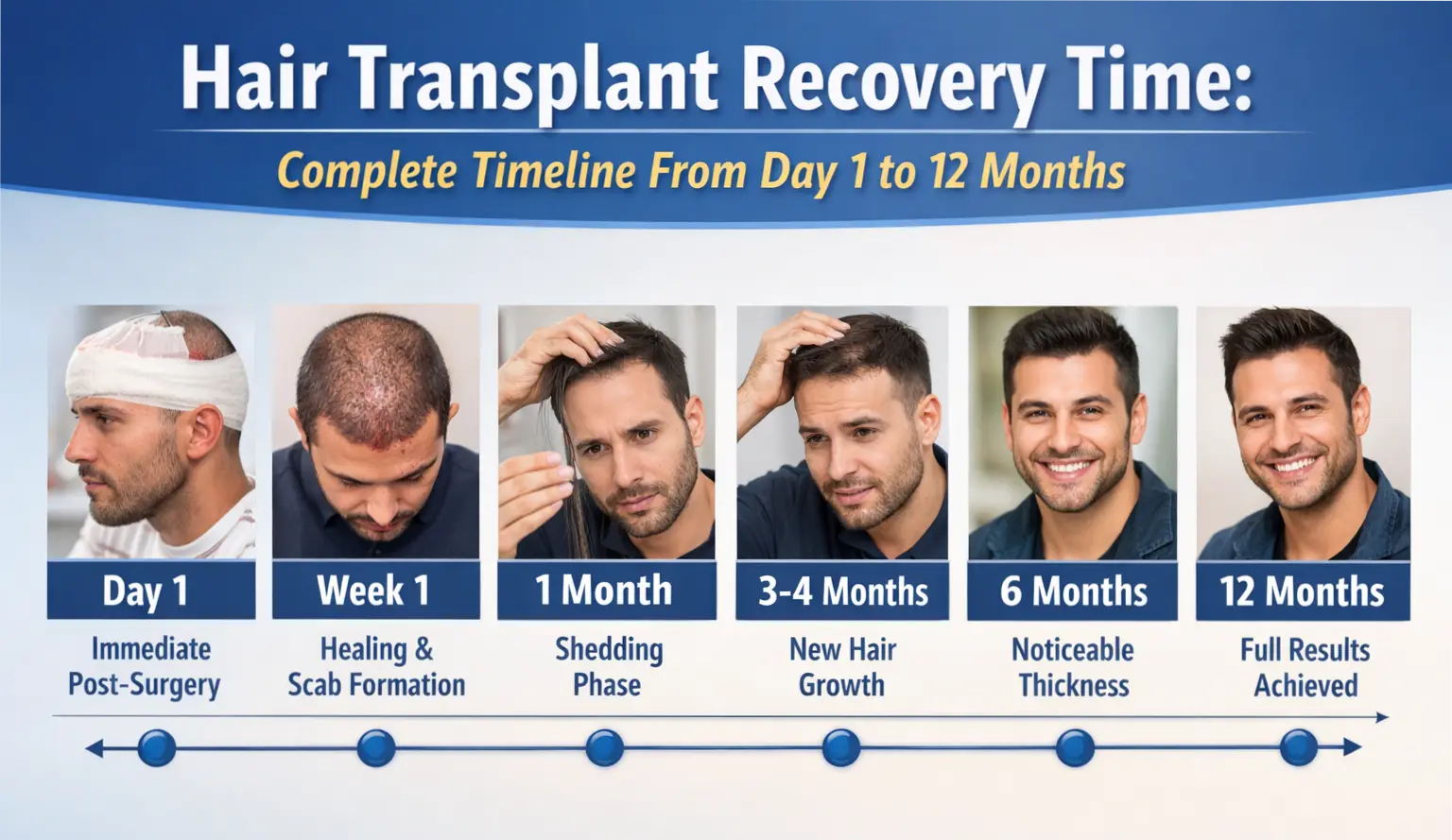
Hair Transplant Recovery Time: Complete Timeline From Day 1 to 12 Months
Choosing a hair transplant in Mumbai is often the easy part. The bigger worry for most patients is what happens afterwards. They want to know the real hair transplant recovery time, whether swelling is normal, when they can wash the scalp, when hair will start growing, and how soon they can return to work. Recovery happens in phases, not all at once. Whether the procedure is FUE or FUT, the scalp usually heals in about 1 to 2 weeks, while visible new growth commonly starts around 3 to 4 months and final results may take close to a year. At Viva Aesthetic Clinic, procedures are positioned around surgeon-led planning and follow-up under Dr. Deepam Shah.
Understanding the Healing Process
A hair transplant works by moving healthy hair follicles from the donor area to thinning or bald parts of the scalp. After implantation, those follicles do not simply start growing overnight. They pass through a sequence of healing, shedding, resting, and regrowth that follows the normal hair growth cycle. This is why patients may see crusting early on, hair fall a few weeks later, and then delayed regrowth after that. The shedding phase can be alarming, but it is usually part of normal recovery rather than a sign that the transplant has failed.
Hair Transplant Recovery Timeline
Day 1–3 After Hair Transplant
The first few days are focused on protecting the grafts and controlling inflammation.
What is normal in this phase:
- Mild swelling
- Redness in the recipient area
- Small scabs or crusts around grafts
- Slight discomfort or tightness
Important care during this phase:
- Sleep with your head elevated
- Do not touch, rub, or scratch the grafts
- Use saline spray if prescribed
- Take medicines exactly as advised
Temporary side effects such as swelling, scabs, pain, itching, and tightness are common after surgery.
Day 4–7 After Hair Transplant
By this stage, most patients feel much better and the recovery looks less dramatic.
What usually changes:
- Swelling starts reducing
- Scabs become more obvious before they loosen
- The scalp looks calmer than the first 2 to 3 days
- A gentle hair wash may be allowed, based on your surgeon’s instructions
Day 7–14 After Hair Transplant
This is the stage many patients are most curious about because they want to know what hair transplant after 10 days should look like.
What often happens now:
- Scabs begin to fall off naturally
- Redness fades gradually
- Grafts become more secure
- Most obvious signs of surgery improve significantly
If you are wondering about hair transplant after 10 days, the scalp usually looks much more settled than it did in the first week, though minor pinkness or dryness may still remain. The Medical guidelines indicate that by 10 to 14 days, stitches from FUT can usually be removed if non-dissolvable sutures were used.
Why Hair Falls After a Transplant
One of the most misunderstood stages is shock loss. Between about 2 and 8 weeks after surgery, the transplanted hairs often shed. The American Academy of Dermatology says this is normal, and the NHS also notes that the transplanted hair often falls out after a few weeks before growing back later. What falls is the hair shaft, not necessarily the follicle itself. The follicle remains under the scalp and later re-enters a growth phase. This temporary shedding can look worse in people who already have androgenetic alopecia, but it is usually expected during recovery.
If a patient checks the mirror at 20 days after hair transplant, it is common to see a scalp that looks healed but not “full.” At that point, healing and hair growth are still two different things. The scalp may be improving, while visible density is still weeks to months away.
Month-by-Month Hair Growth Stages
Month 1–2
This is often the quietest phase and sometimes the most frustrating.
- Follicles are adapting to their new blood supply
- Little visible growth is expected
- Some shedding may still continue
- The scalp often looks more normal than the hairline does
This stage can make patients feel that nothing is happening, but biologically, the follicles are still settling.
Month 3–4
This is when early regrowth often starts.
- Fine baby hairs begin to appear
- Texture may look thin or uneven at first
- Early outline of the hairline becomes visible
The NHS says new hair usually starts to appear after 4 months, while AAD says many patients see growth beginning around this period, even though density is still developing.
Month 5–6
This is when improvement becomes more visible in photographs and in day-to-day life.
- Hair strands become thicker
- Coverage starts improving
- The result begins to look more intentional and less patchy
AAD says many patients start seeing results between 6 and 9 months, though complete maturation can still take longer.
Month 9–12
This is the stage when most patients judge the success of the transplant.
- Final hairline shape becomes clearer
- Density improves further
- Texture and thickness look more natural
- The overall result blends better with native hair
Most patients see results between 6 and 9 months, but some take 12 months.
Why Recovery Time Varies From Person to Person
No two patients have the same hair implant recovery time or recovery time from a hair transplant. Recovery depends on a combination of surgical and patient factors.
Common factors that influence recovery:
- Technique used: FUE vs FUT
- Graft handling and survival
- Surgeon experience
- Scalp condition and overall health
- Smoking or alcohol use
- How carefully are aftercare instructions followed
Viva’s hair transplant page states that both FUE and FUT are offered, and it emphasises careful graft handling, personalised planning, and post-operative follow-up. Candidate selection on the same page also highlights factors such as general health, donor quality, and understanding the timeline of expected results.
Essential Post-Transplant Care
Good aftercare improves comfort and supports graft survival.
Do:
- Follow your doctor’s instructions closely
- Use the prescribed shampoo or cleanser
- Sleep with your head elevated
- Take antibiotics or pain medicines if prescribed
- Attend follow-up visits
Avoid:
- Scratching the scalp
- Intense exercise too early
- Direct sun exposure
- Smoking
- Picking at scabs
Recovery Milestones
Patients usually find reassurance in simple timelines.
- Return to work: about 3–5 days for many desk jobs
- Gentle hair washing: around day 6 in many cases
- Hair transplant after 10 days: scalp often looks much calmer, with most grafts secure
- 20 days after hair transplant: healing is usually ahead of visible growth
- Exercise: often around 3 weeks, depending on surgeon advice
- Visible growth: around 3–4 months
- Full results: around 12 months, sometimes longer
If patients are also comparing budgets while planning surgery and aftercare, Viva’s current cost of hair transplant in Mumbai page says pricing typically ranges from ?30,000 to ?2,00,000 depending on graft count, technique, and case complexity.
Common Side Effects During Recovery
Temporary side effects do not always mean a complication.
Common short-term effects include:
- Swelling (edema)
- Itching
- Redness
- Numbness or reduced feeling
- Scabs
- Shock loss
When to Contact a Doctor
Some symptoms should not be ignored.
Call your doctor if you notice:
- Severe pain
- Persistent or worsening redness
- Green or yellow pus
- A fever that does not go away
- Excessive bleeding
- Swelling that seems to worsen instead of improve
Who Is a Good Candidate for Hair Transplant?
A good candidate is not defined only by baldness. It is also about donor quality and realistic planning.
Ideal candidates often include:
- People with male pattern baldness / androgenetic alopecia
- Patients with a stable donor area
- People in good general health
- Those with realistic expectations
A recent StatPearls overview says ideal candidates usually have stable, well-defined hair loss, healthy scalp tissue, good donor density, and realistic expectations. Viva’s main hair transplant page likewise highlights androgenic alopecia, healthy donor follicles, and understanding the timeline of results as important screening factors.
Final Thoughts
The real answer to “how long does hair transplant recovery take?” is two-part: scalp healing is relatively quick, but cosmetic patience takes longer. The early hair transplant healing stages usually settle within 1 to 2 weeks, but the full hair transplant results timeline unfolds over months. That is why patients should judge the procedure by the one-year mark, not by the first few weeks. If you are planning a procedure or want a personalized recovery roadmap, learn more about Dr. Deepam Shah and the clinic’s approach to hair transplant in Mumbai. For appointments or treatment guidance, please contact us.
FAQs
How long does hair transplant recovery take?
Physical healing often takes around 1 to 2 weeks, but visible regrowth typically starts after about 3 to 4 months and final results may take around a year.
When can I wash my hair after hair transplant?
Gentle washing by hand is usually possible around day 6, but patients should always follow their own surgeon’s instructions first.
Is swelling normal after hair transplant?
Yes. Mild swelling is a common temporary side effect in the first few days after surgery.
When does transplanted hair start growing?
New hair often starts appearing around month 3 to 4, though thicker and more visible growth takes longer.
Can I exercise after a hair transplant?
It is seen that after the transplant procedure, many patients return to sports after about 3 weeks, though exact timing depends on the surgeon’s advice and the type of procedure.
When will hair transplant results be visible?
Many patients notice meaningful improvement by 6 to 9 months, but final results may take up to 12 months or, in some cases, 10 to 18 months.
How painful is hair transplant recovery?
Most patients describe the recovery as mild discomfort, tightness, itching, or soreness rather than severe pain. Severe pain should be reported to the doctor.
Does hair transplant leave scars?
Scarring depends on technique. Viva’s hair transplant page says FUE is positioned as minimally invasive with no visible scars, while FUT involves a strip removal and leaves a permanent scar that is usually concealed by surrounding hair.