
“You finally reached your weight-loss goal—but suddenly there is hair everywhere.”
On the pillow. In the shower. On your clothes. And every time you run your fingers through your hair, a few more strands seem to come out.
Hair shedding after significant weight loss can be alarming, especially when you have been eating healthier and exercising specifically to improve your health. However, the problem may not be the fact that you lost weight—it may be how quickly your body experienced the change and whether it received enough nutrition during the process.
A 2024 study involving 140 patients with weight-loss-associated telogen effluvium found an average weight reduction of about 15% of body weight, with an average loss of approximately 3.5 kg per month. This does not mean those numbers will cause hair loss in everyone, but they demonstrate an association between substantial weight reduction and temporary shedding.
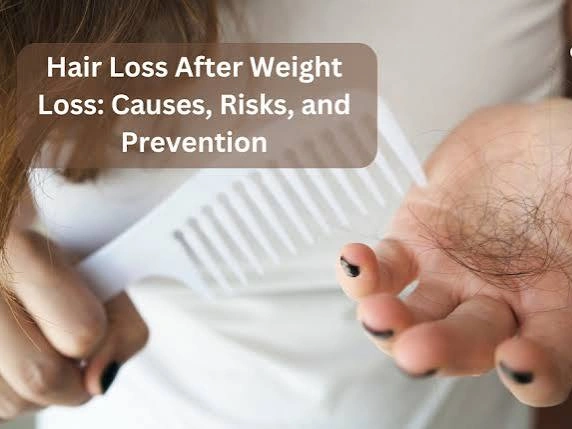
This type of diffuse shedding is frequently associated with telogen effluvium, in which a physiological stressor causes more hairs than usual to shift into the resting phase of the hair-growth cycle.
Dr Deepam Shah, MD, DNB, FAM, is a Dermatologist, Cosmetologist and Hair Transplant Surgeon with more than a decade of experience. At Viva Aesthetic Clinic, Mumbai, patients experiencing sudden hair shedding can be evaluated to identify whether weight loss, nutritional changes, pattern hair loss or another condition is responsible.
Your Hair May React to the Speed of Weight Loss
The body does not interpret weight loss in terms of appearance.
It responds to changes in energy availability.
When calorie intake drops substantially over a relatively short period, the body has to adapt to a new nutritional and metabolic environment.
Hair production is biologically active, but it is not essential for immediate survival. During significant physiological stress, the normal hair-growth cycle can therefore be disrupted.
More follicles may leave their active growth phase and eventually enter the shedding phase.
This helps explain why two people losing the same number of kilograms may have completely different hair experiences.
One may lose weight gradually while maintaining adequate nutrition.
Another may lose the same amount rapidly through severe calorie restriction.
The number on the weighing scale may be identical, but the physiological journey was not.
The Hair Fall May Start After Your Diet Has Ended
One of the most confusing features of weight-loss-related shedding is its delay.
Suppose you started an aggressive diet in January.
You lost weight during January and February.
By March, you were eating normally again.
Then in April, your hair suddenly began shedding.
Naturally, you might think:
“My diet ended weeks ago. How could that be causing this?”
Hair follicles do not necessarily shed immediately after a trigger.
In telogen effluvium, noticeable shedding commonly appears approximately 2–3 months after a triggering event.
That timeline provides an important diagnostic clue.
When investigating sudden hair fall, a dermatologist may therefore ask what happened several months earlier rather than only what changed last week.
Recent weight loss, fever, surgery, illness, major stress and dietary restriction can all become relevant.
Eating Less Can Accidentally Mean Eating Too Little Protein
Many weight-loss diets focus almost entirely on calories.
But your hair follicles also require nutritional building blocks.
Hair is predominantly composed of keratin, a protein. If a restrictive diet significantly reduces protein intake, hair growth can be affected.
Research on nutrition and hair loss recognises both sudden weight loss and decreased protein intake as potential triggers for acute telogen effluvium.
This becomes particularly relevant when people lose weight by:
- Skipping meals repeatedly
- Following extreme low-calorie plans
- Replacing most meals with drinks
- Removing several food groups
- Eating very small portions without nutritional planning
- Following poorly designed crash diets
A “healthy-looking” salad-based diet can still be nutritionally inadequate if it repeatedly fails to provide sufficient protein and other essential nutrients.
Weight-loss planning should therefore consider nutritional quality as well as calorie quantity.
Iron and Other Nutritional Problems May Be Hiding Behind the Shedding
Sometimes the weight loss itself is only part of the story.
Restrictive eating can reduce the intake of several nutrients.
Depending on medical history and diet, a dermatologist may consider whether deficiencies or abnormalities involving nutrients such as iron or vitamin D are relevant. A recent systematic review found lower ferritin and vitamin D levels among telogen effluvium patients compared with controls, although nutritional associations with hair loss are complex.
This does not mean every person experiencing shedding should immediately purchase iron, zinc, vitamin D, biotin and multiple “hair vitamins”
More supplements are not automatically better.
Nutritional reviews have specifically cautioned that supplementation without an established deficiency may provide no proven benefit, while excessive intake of certain nutrients can itself cause problems.
The better approach is to identify whether a deficiency actually exists and correct it appropriately.
Weight-Loss Injections Can Be Part of the History Too
Another increasingly relevant question is how the weight was lost.
GLP-1-based weight-management medications can produce substantial weight reduction in some patients.
Hair thinning has been reported among people using these medications. Dermatologists believe that rapid weight reduction and reduced intake of protein or other nutrients may contribute to telogen effluvium in some patients, although research is continuing into whether the medications themselves may also play a role.
If your shedding began after starting a prescription weight-management medication, tell both the doctor managing your weight and your dermatologist.
Do not independently discontinue a prescribed medication because you notice hair fall.
The more useful step is to establish:
- What type of hair loss is occurring?
- How quickly has weight been lost?
- Has food intake changed substantially?
- Is nutrition adequate?
- Could another medical condition be contributing?
This allows the problem to be approached without automatically blaming one medication.
Temporary Shedding Can Reveal Hair Loss That Was Already Developing
Here is another possibility that patients may not expect.
You may have had early androgenetic alopecia, or pattern hair loss, before losing weight without noticing it.
Your hair density was sufficient to disguise the gradual thinning.
Then telogen effluvium caused a sudden increase in shedding.
The scalp became more visible, and an underlying pattern of thinning became easier to recognise.
In this situation, the patient may actually have two processes occurring together.
This distinction matters because their long-term management is different.
Telogen effluvium associated with a temporary trigger can improve once the trigger resolves, whereas pattern hair loss is a progressive condition that may require separate management.
A scalp examination and, where appropriate, trichoscopy can help differentiate them.
When Should Hair Loss, After Weight Loss Be Checked?
Not every episode of increased shedding requires panic.
But certain patterns deserve professional evaluation.
Consider seeing a dermatologist if:
- Shedding is particularly heavy
- Hair loss continues for several months
- Your scalp is becoming increasingly visible
- The central parting appears wider
- You develop clearly defined bald patches
- Your scalp is painful, inflamed or persistently itchy
- Hair is breaking rather than shedding from the root
- You have unexplained fatigue or other symptoms
- Weight loss itself was unexplained
- You have undergone bariatric surgery
- You suspect significant nutritional restriction
Unintentional weight loss accompanied by hair loss should not simply be assumed to be a cosmetic problem.
The underlying reason for the weight change may itself require medical assessment.
Recovery Starts With Correcting the Trigger, Not Chasing Hair Products
When handfuls of hair suddenly begin shedding, it is tempting to buy everything labelled “anti-hair fall.”
Shampoo.
Serum.
Oil.
Gummies.
Biotin.
Protein powder.
Scalp injections.
But telogen effluvium is fundamentally a response to a trigger.
Management therefore begins by identifying and correcting that trigger where possible.
If severe dietary restriction is responsible, nutrition needs attention.
If laboratory testing confirms a deficiency, that deficiency can be appropriately corrected.
If another form of alopecia is present, it may require its own treatment.
And if the episode is uncomplicated acute telogen effluvium following a temporary stressor, reassurance and time may form an important part of management. Reviews describe telogen effluvium following sudden weight loss as generally having a high rate of remission.
Dr Deepam Shah completed his MBBS from the University of Bombay and DNB in Dermatology & Venereology from the University of Delhi. He also holds Fellowship training in Aesthetic Medicine and Hair Transplant.
At Viva Aesthetic Clinic, Mumbai, patients experiencing excessive shedding can have their scalp and hair-loss pattern evaluated before treatments or supplements are recommended.
The objective is to treat the reason your hair is falling, rather than simply adding more products to your bathroom shelf.
Losing weight and losing hair at the same time can feel contradictory—you made a change for your health, yet your hair suddenly seems worse.
The connection often becomes clearer when you look beyond the weighing scale.
Rapid weight reduction, significant calorie restriction, insufficient protein, nutritional deficiencies and the physiological stress of major body changes can disturb the normal hair-growth cycle. The shedding may not become obvious until several months after the triggering period.
Most importantly, sudden shedding does not automatically mean permanent baldness.
Dr Deepam Shah, MD, DNB, FAM, is a Dermatologist and Hair Transplant Surgeon with more than a decade of experience. At Viva Aesthetic Clinic, Mumbai, patients experiencing hair loss after weight reduction can be evaluated to distinguish temporary shedding from nutritional problems, pattern hair loss and other causes.
Frequently Asked Questions
Will my hair grow back after weight-loss-related shedding?
If the shedding is due to acute telogen effluvium and the underlying trigger has resolved, recovery is often possible because this is a non-scarring form of hair loss. However, the timeline varies and another hair-loss condition can sometimes coexist.
How much weight loss is enough to cause hair fall?
There is no universal kilogram cut-off. A 2024 study of 140 affected patients reported an average loss of about 15% of body weight and around 3.5 kg per month, but these are study averages—not thresholds that predict what will happen to an individual.
Should I stop trying to lose weight because my hair is falling?
Not necessarily. Achieving a medically appropriate weight can have important health benefits. The issue may be rapid loss, excessive restriction or inadequate nutrition rather than weight reduction itself. Discuss your diet and rate of weight loss with an appropriate healthcare professional.
Should I take biotin after losing weight?
Do not assume biotin is the missing nutrient. Evidence does not support high-dose biotin as a general treatment for hair loss when biotin deficiency is absent.
Can bariatric surgery cause hair shedding?
Hair loss can occur after bariatric surgery. Early shedding may relate to the physiological stress of surgery and rapid weight reduction, while later or persistent problems can also involve nutritional deficiencies, making appropriate postoperative monitoring important.
Can I prevent hair loss while dieting?
There is no guaranteed prevention method. Avoiding unnecessarily extreme calorie restriction, maintaining an appropriately balanced diet and ensuring adequate protein and micronutrient intake can reduce avoidable nutritional stress. A dietitian or doctor can help when significant weight reduction is planned.
Do I need PRP or GFC immediately for this type of hair loss?
Not automatically. Indian expert consensus notes that PRP has no established role in acute telogen effluvium and unnecessary treatment should be avoided. The cause and type of hair loss should be established before deciding on procedural therapy.