“Why does my face look tired even when I feel fine?”
Sometimes it is not tiredness at all. Repeated frowning, smiling, squinting and eyebrow movements can gradually leave visible lines on the face. For some people, these lines eventually remain noticeable even when their facial muscles are relaxed.
This concern is becoming increasingly relevant as interest in non-surgical aesthetic procedures grows in India. The Indian medical aesthetics market is valued in the billions of dollars, with minimally invasive facial procedures forming part of the growing demand for treatments that require less downtime than surgery.
Facial Botox treatment is one option used to temporarily reduce selected muscle activity responsible for certain expression lines. Rather than changing the basic structure of the face, treatment can be planned around specific muscles and individual concerns.
Dr Deepam Shah, MD, DNB, FAM, is a Skin Specialist in Mumbai, Dermatologist, Cosmetologist and Hair Transplant Surgeon with more than a decade of experience in skin, hair and aesthetic treatments. At Viva Aesthetic Clinic, Mumbai, facial Botox is considered only after assessing the patient’s facial anatomy, muscle activity, medical history and expectations.
If you are considering the treatment for the first time, understanding where it works—and where it does not—is important.
What Exactly Does Botox Change in Your Face?
Botox does not work by filling a wrinkle.
Instead, it temporarily affects communication between nerves and selected muscles. This reduces the strength of contraction in the treated muscles.
Why does this matter for wrinkles?
Consider what happens when you frown. The muscles between your eyebrows contract and pull the skin into folds. Repeating this movement over many years can make the creases increasingly noticeable.
By reducing excessive contraction in carefully chosen muscles, Botox can soften the appearance of these movement-related lines.
It is therefore primarily a muscle-focused treatment, rather than a treatment for every type of facial ageing.
This distinction is important when deciding whether Botox is appropriate for your concern.
Which Parts of the Face Can Be Considered?
Most people associate Botox with forehead wrinkles, but facial muscle activity can create lines in several areas.
Commonly considered areas include:
Forehead
Horizontal lines develop when the muscles responsible for lifting the eyebrows repeatedly contract.
Between the Eyebrows
Frown lines, sometimes called “11 lines,” can become prominent between the eyebrows. In some people, strong frown muscles make these lines visible even when they are not actively frowning.
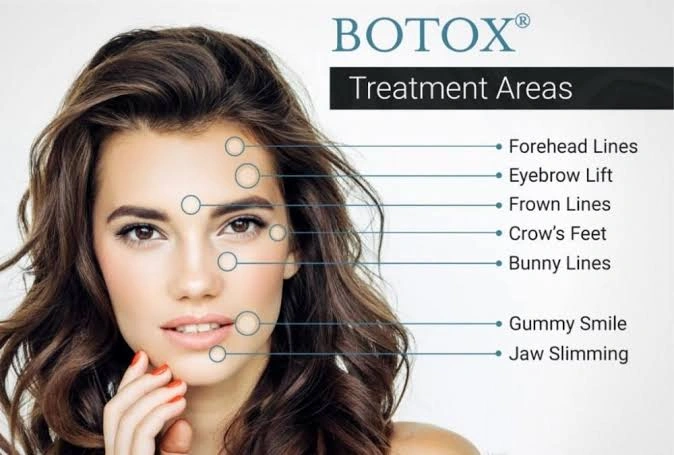
Around the Eyes
Crow’s feet appear at the outer corners of the eyes, particularly while smiling or squinting.
Other Selected Areas
Botox may have additional facial applications when clinically appropriate. These require careful assessment because muscles in the lower face have important roles in expressions and movement.
Not every visible facial line should automatically be injected. The location, cause and function of the underlying muscle need to be considered first.
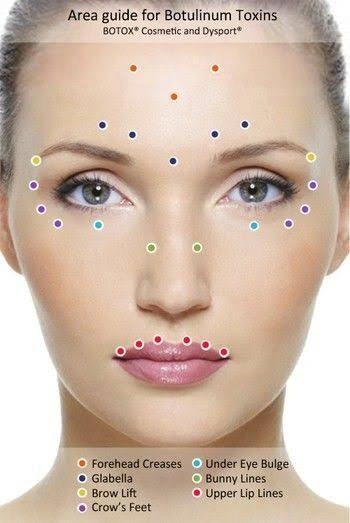
Facial Mapping Makes Every Treatment Different
Your face is not perfectly symmetrical—and it does not need to be.
One eyebrow may naturally sit slightly higher. You may smile more strongly on one side. Your forehead may also move differently from another person’s.
These small differences become important during facial Botox treatment.
Before selecting injection points, a dermatologist may examine your face at rest and ask you to make different expressions.
This helps assess:
- Facial muscle strength
- Direction of muscle movement
- Existing asymmetry
- Eyebrow position
- Depth of expression lines
- Interaction between neighbouring muscles
The injection plan can then be developed around your anatomy.
This is why copying the number of units or injection points received by a friend or celebrity is not useful. Their facial movement pattern is not yours.
What Happens on the Day of Treatment?
A facial Botox appointment should begin with consultation rather than immediately with injections.
Explain which changes are bothering you and what type of outcome you are expecting.
Your dermatologist should also know about your medical history, medications, supplements and previous aesthetic treatments.
Once the treatment areas have been selected, the skin is cleaned and injection points are identified.
Small quantities of the medication are administered using a fine needle.
You may feel a quick pinching or stinging sensation. Individual sensitivity varies, and the number of injections depends on the areas being treated.
Because no surgical incision is required, the procedure itself is generally relatively quick.
However, the consultation and facial assessment should not be rushed simply because the injections take only a short time.
Your Face Will Not Change the Moment You Leave
Patients sometimes look into the mirror immediately after treatment expecting to see the final result.
Botox does not work that way.
Its effect develops progressively as the targeted muscles begin responding.
You may gradually notice that it becomes more difficult to produce the same strong crease when frowning or raising your eyebrows.
The visible effect on wrinkles depends partly on how established those lines were before treatment.
An early expression line that disappears when the face relaxes may behave differently from a deep crease that has been present for years.
The latter may remain partially visible because changes have already developed within the skin itself.
Your dermatologist can explain what degree of improvement is realistic after examining the area.
What Happens During the First Few Days?
Facial Botox generally does not involve prolonged recovery.
Nevertheless, the injection sites can show temporary reactions.
These may include:
- Mild redness
- Small bumps
- Tenderness
- Swelling
- Occasional bruising
Patients can often continue many normal daily activities, although specific aftercare instructions should be followed.
You may be advised to avoid unnecessary rubbing or pressure over freshly treated areas. Certain strenuous activities, massages, facials or aesthetic procedures may also need to be postponed temporarily.
If you are planning treatment around a wedding, photoshoot or major event, schedule your consultation in advance.
This allows time for temporary injection-site effects to settle and for the treatment response to develop.
When Botox May Not Be the Answer
This is particularly important for patients choosing a facial treatment for the first time.
You may look in the mirror and think, “My face looks older, so I need Botox.”
But the change may have little to do with excessive muscle activity.
For example, your primary concern could actually be:
- Pigmentation
- Sun-damaged skin
- Acne scars
- Uneven texture
- Enlarged pores
- Loss of facial volume
- Skin laxity
- Under-eye hollowness
Botox is not designed to directly correct these problems.
Similarly, Botox and dermal fillers are not interchangeable.
Fillers are generally used when adding or restoring volume is required, while Botox primarily alters selected muscle activity.
A dermatological assessment can help determine what is actually producing the change you see in the mirror before a procedure is selected.
Natural Facial Movement Should Be Part of the Plan
One of the most common concerns about facial Botox is looking expressionless.
Aesthetic treatment should consider how the different muscles of the face work together.
For example, forehead muscles do more than create wrinkles. They also participate in eyebrow movement. Treatment planning therefore needs to consider both the visible lines and the function of the muscles underneath them.
Your preferred outcome should also be discussed.
Some patients may want noticeable reduction of a particular expression line. Others may prioritise retaining greater movement.
Dr Deepam Shah completed his MBBS from the University of Bombay and DNB in Dermatology & Venereology from the University of Delhi. He also holds a Fellowship in Aesthetic Medicine and Hair Transplant.
With more than a decade of experience, he practises as a Dermatologist, Cosmetologist and Hair Transplant Surgeon in Mumbai. He is a Silver Medalist in the MUHS examination and has been recognised as Best Post Graduate Student for the Galderma Institute.
At Viva Aesthetic Clinic, a 1000 sq. ft. clinic in Mumbai equipped with advanced aesthetic devices and laser technologies, Dr Deepam Shah evaluates facial anatomy and individual concerns before planning treatment.
Frequently Asked Questions
At what age should I consider facial Botox?
There is no standard age at which everyone should begin Botox. Treatment should be based on the type of lines, facial muscle activity, medical suitability and how much the concern bothers the individual rather than age alone.
Is facial Botox painful?
The procedure uses a fine needle and may cause a brief pinching or stinging sensation at individual injection points. Sensitivity differs from person to person.
Will Botox make my face look bigger or smaller?
Botox is not primarily a facial-volume treatment. Its effect depends on which muscles are being treated and the reason for treatment. Any expected change should be discussed before the procedure.
Can I have Botox on only one area of my face?
Treatment can be limited to a particular concern when clinically appropriate. However, the dermatologist should assess neighbouring muscles because facial muscles influence one another.
Is facial Botox permanent?
No. Its effect is temporary. Muscle activity gradually returns over time, and further treatment is optional.
Can I have a facial or massage after Botox?
Certain facial procedures or massage may need to be temporarily avoided following injections. Ask your treating dermatologist when it is appropriate to restart them.
How do I know whether Botox or another facial treatment is better for me?
It depends on what is causing your concern. Muscle-related expression lines may be considered for Botox, while pigmentation, volume loss, scars or skin laxity may require completely different approaches. A facial and skin assessment helps determine the appropriate option.
Facial Botox is not simply about removing as many wrinkles as possible. It is a treatment that works by temporarily modifying selected muscle activity, making careful assessment particularly important.
Before deciding, identify what bothers you and discuss the result you would like to achieve. Understanding your facial anatomy, the cause of the lines and the limitations of treatment can help establish realistic expectations.
Dr Deepam Shah, MD, DNB, FAM, is an experienced Skin Specialist in Mumbai, Dermatologist, Cosmetologist and Hair Transplant Surgeon. At Viva Aesthetic Clinic, Mumbai, patients can have their facial concerns assessed before deciding whether Botox or another aesthetic approach is suitable.
The goal of facial aesthetic treatment should be individual—not to copy another face, but to choose an approach that respects your own features, expressions and treatment preferences.